



Before aquamarine becomes a pendant, it begins far from the jeweler's bench: deep within the Earth, where minerals crystallize as rock cools. Its soft, sea-blue colour may suggest water, but its story is one of geology, time and extraordinary natural variation.
Where does aquamarine come from? Why are some stones pale and others distinctly blue? And what should you look for when choosing a genuine raw aquamarine necklace? Here is a closer look at the stone before it becomes jewelry.
Where does aquamarine come from?
Aquamarine is the blue to greenish-blue variety of the mineral beryl. It occurs in several regions of the world, including Brazil, Pakistan, Nigeria, Madagascar, Mozambique and Zambia. The name comes from the Latin for “seawater,” but aquamarine does not grow in the ocean. It forms in rock, commonly in mineral-rich formations called granitic pegmatites.
Brazil's Minas Gerais region has a long history of producing aquamarine and other gem beryls. Pakistan's Karakoram mountains are known for striking aquamarine specimens found at high elevations. Africa also has important deposits. These locations help tell the geological story, but a country's reputation alone cannot establish the quality or provenance of an individual gemstone.
How is aquamarine formed?
Aquamarine and emerald are relatives: both belong to the beryl mineral family. Beryl has the chemical formula Be₃Al₂Si₆O₁₈, and small amounts of other elements influence its appearance. In aquamarine, iron is responsible for the characteristic blue to greenish-blue colour.
Many aquamarine crystals grow in pegmatites, coarse-grained igneous rocks associated with the final stages of crystallization of certain magmas. Under the right conditions, minerals have space and time to develop unusually large, well-formed crystals. Beryl often forms six-sided prisms. In a natural specimen, that geometry can be beautiful without any cutting at all.
Not every crystal develops in the same way. A stone may have an uneven surface, cloudy areas, internal features or variations in colour. These characteristics are especially visible in raw jewelry, where the gemstone's natural shape is part of the design rather than something to remove.
Why is aquamarine blue?
Iron in beryl's crystal structure produces aquamarine's colour. One stone may be almost transparent with a hint of blue; another may look distinctly blue-green. Lighting also changes how we perceive a gemstone, so it is worth looking at photographs taken from different angles.
Some aquamarine is heat-treated to reduce greenish tones and create a bluer appearance. This is an established gem-trade practice. A natural gemstone is not necessarily an untreated gemstone: “natural” describes its formation in the Earth, while “untreated” is a separate statement about what happened after mining. Ask about known treatments when this distinction matters to you.
Aquamarine around the world
Brazil: a historic source
Minas Gerais is celebrated for gem-bearing pegmatites, including deposits of beryl. Its long mining history has made Brazilian aquamarine familiar to collectors and jewelers alike.
Pakistan: crystals from the mountains
In northern Pakistan, aquamarine occurs in dramatic mountain settings in the Karakoram region. Some deposits are worked at considerable elevation. The setting is memorable, although the individual crystal's colour, condition and appearance matter more to a jewelry buyer than the romance of its source.
Africa and other deposits
Nigeria, Madagascar, Mozambique and Zambia are also documented aquamarine sources. The mineral is found in additional countries as well; it is not exclusive to one continent.
About gemstone provenance: These are documented worldwide sources, not a statement that a particular Designs by Nature Gems stone was mined in any one of them. Specific mine or country claims should be supported by reliable documentation. Responsible sourcing and precise geographic traceability are related, but they are not the same promise.
Where our aquamarine gemstones are sourced
At Designs by Nature Gems, the origin of an aquamarine depends on the individual jewelry design. Our studio's product sourcing records identify several countries for different styles. These are our recorded sourcing origins, not independent mine-of-origin certifications, and they should not be taken to mean that every aquamarine design comes from the same place.
Brazilian raw aquamarine: statement necklaces
Our sourcing records list Brazil for several raw aquamarine statement necklace designs, including the sterling silver statement necklace (SKU RAQ-SN-SS-18), sterling silver with leather cord (RAQ-SN-SS-BLC-24), and 14k gold-filled chain statement design (RAQ-SN-14GF-18). These pieces celebrate the texture and irregular character of raw crystal.
Madagascar aquamarine: statement and pearl designs
Several aquamarine statement styles and aquamarine-with-pearl necklaces are recorded as sourced from Madagascar, including the aquamarine-and-pearl gold-chain statement necklace (AQ-PRL-SN-GP-24) and silver-plated version (AQ-PRL-SN-SP-24). These designs offer a different interpretation of aquamarine from the raw statement pieces.
India and China: moon and charm designs
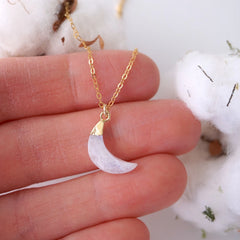
Our aquamarine moon necklaces in sterling silver (AQ-MN-SS-18) and gold (AQ-MN-14KG-18) list India as their stone origin. Several aquamarine wire-wrapped and plated charm necklaces, including AQ-RCN-SP-22 and AQ-CN-SP-18, list China.
A note on provenance: These country associations come from our design-level sourcing spreadsheet. Some other aquamarine entries have no origin recorded; we do not assign them a country without documentation. Origins can also vary by material batch, so please contact our studio if the country of origin matters for the exact gemstone you are selecting.
Explore our aquamarine collection to discover different designs, or choose an eligible piece and ask to see the individual gemstones available for your necklace.
Why is aquamarine associated with the sea?
Its name means “seawater,” and historical traditions linked aquamarine with safe passage for sailors. These stories are part of the stone's cultural history, not scientifically demonstrated protective effects.
Aquamarine is also a March birthstone and a traditional gemstone for the nineteenth wedding anniversary. That makes it a thoughtful choice for someone marking a birthday or milestone—or simply someone drawn to the colour of water.
Raw versus polished aquamarine: what is the difference?
Raw aquamarine retains a relatively natural-looking surface and outline. Polished aquamarine has been smoothed or shaped to highlight its finish, colour or transparency. Neither term, on its own, guarantees authenticity or tells you whether a stone has been treated.
Polished aquamarine often appeals to people who love a luminous, even finish. Raw aquamarine offers a different pleasure: texture, asymmetry and the visible character of an individual crystal. Neither is inherently better. The right choice is the one you find yourself looking at twice.
At Designs by Nature Gems, our Toronto artisans work with the shape of each natural stone. Rather than forcing every crystal into an identical setting, they shape the wire around the gemstone in front of them. That is part of the appeal of handcrafted raw gemstone jewelry: the stone guides the finished piece.
How to choose a genuine raw aquamarine necklace
Begin with the actual stone. Notice the colour, size, proportions and surface texture. Ask whether it is natural aquamarine, what is known about any treatments, and whether you will receive the gemstone shown. Check the necklace material and length, too; a beautiful stone deserves a setting that suits how you plan to wear it.
Our genuine raw aquamarine necklace in sterling silver is individually wire-wrapped in Toronto. For this design, select “Choose My Aquamarine — We'll Email You” on the product page. We then send photographs of available stones so you can choose the exact aquamarine that will become your pendant.
To compare other styles and finishes, explore our aquamarine jewelry collection. For a closer look at our workbench, visit How It's Made: The Hands Behind Every Stone.
How to care for aquamarine jewelry
Aquamarine measures 7.5–8 on the Mohs hardness scale, making it reasonably durable for jewelry. Hardness measures resistance to scratching, however, not immunity to impacts. Remove your piece for strenuous activities and protect it from harsh chemicals and sudden heat.
For a handcrafted wire-wrapped necklace, gently wipe the gemstone and metal with a soft cloth after wearing. If needed, use a cloth lightly dampened with mild soapy water, then dry carefully; keep leather cords dry. Avoid ultrasonic and steam cleaners unless a professional has assessed the stone, setting and any inclusions or treatments.
Frequently asked questions about aquamarine
Does aquamarine come from the ocean?
No. Although its name refers to seawater, aquamarine forms in rock, often in granitic pegmatites.
Which countries produce natural aquamarine?
Documented sources include Brazil, Pakistan, Nigeria, Madagascar, Mozambique and Zambia, among others. A particular stone's origin should not be assumed without supporting evidence.
Is raw aquamarine real aquamarine?
It can be. “Raw” describes the presentation of the stone, not a laboratory confirmation of its identity. Ask the seller about gemstone identification and available documentation.
Is aquamarine always pale blue?
No. It can range from pale blue to stronger blue and greenish-blue tones. Iron influences the colour, and some stones are heated to appear bluer.
Can I choose the exact aquamarine in my necklace?
Yes, on selected Designs by Nature Gems pieces. Choose the stone-selection option when ordering; we will email photographs of available gemstones so you can select the one you love.
From the Earth to your jewelry box
Part of aquamarine's beauty lies in the distance between its beginning and its finished form: a crystal shaped underground, selected for its individuality, then carefully wrapped by hand. Whether it marks a March birthday or simply catches your eye, there is something special about knowing the stone has its own character.
Explore our raw aquamarine necklace and choose your exact gemstone.
Sources and further reading
Gemological facts and historical context were checked against the Gemological Institute of America aquamarine overview, GIA's March birthstone guide, GIA's aquamarine care guide, and the Burke Museum's science and history notes.


